Bonita Springs Tree Removal handles invasive and exotic tree removal in Bonita Springs, FL, with twenty-plus years on this coast, serving surrounding cities including Estero, Naples Park, Florida Gulf Coast University, Fort Myers Beach and Naples. On a good many of these jobs the removal is not the owner’s preference at all; it is something a local code requires, and the job has to be done to that list.
That makes exotic removal a compliance service as much as a clearing service. Which species must come out, whether they must be kept out afterward, and what documentation is expected all vary between Lee, Collier and Hendry counties and between the municipalities inside them.
It also makes method matter more than it does on ordinary clearing. Cutting a Brazilian pepper thicket without treating the stumps produces a denser thicket, and disturbing melaleuca without a follow-up plan can leave a parcel worse than it started. Doing it once properly is cheaper than doing it three times.
The Species That Come Out, and How Each Behaves
Brazilian Pepper
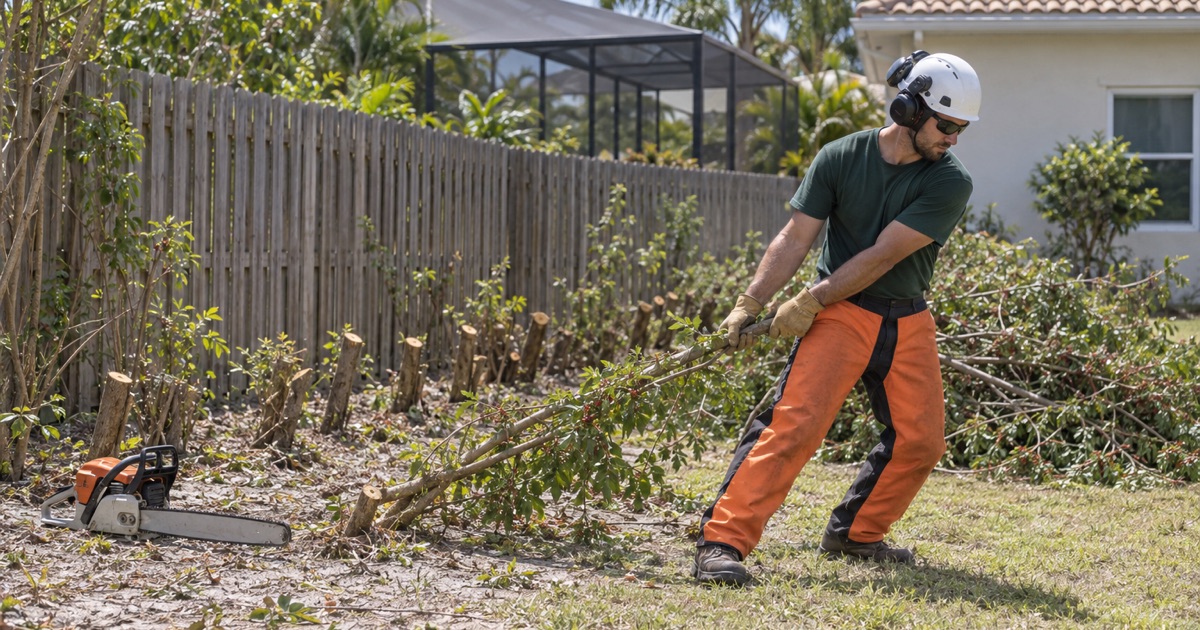
Brazilian pepper is the most common exotic we are called to remove here, and it is the one that most reliably comes back when the job is done badly. It resprouts vigorously from cut stumps and from root material left in the ground, so a purely mechanical clear typically produces a thicker stand within a season. Cutting and treating the stumps in the same operation is what prevents that, and on an established stand a scheduled follow-up is part of the work rather than an extra.
Melaleuca
Melaleuca is the one where disturbance can make the problem worse, because it reseeds heavily in response to damage and stress. That means the sequence and timing of the work matter as much as the equipment, and a mulching head run through a stand with no follow-up plan can be an expensive way of sowing the next generation. We plan the treatment and the return visit before choosing a method, not afterward.
Australian Pine and Earleaf Acacia
Australian pine grows large and leaves trunk material well beyond what a chipper will take, so it is a hauling job with a disposal line attached rather than a mulching job. It is also notably shallow-rooted for its size, which is part of why it features in storm damage here. Earleaf acacia is quicker work but seeds prolifically, and both species tend to occupy the same neglected edges, so a parcel with one usually has the other.
When Removal Is Required Rather Than Chosen
Certificate of Occupancy Conditions
On Sanibel, named invasive species must be removed before a certificate of occupancy is issued, and they must be kept out in perpetuity afterward. That turns exotic removal into a scheduling item on a construction timeline rather than a landscaping preference, and a missed species can hold up a closing. We work to the applicable list rather than to a general idea of what looks invasive, and we record what came out.
County Code Obligations
Collier County imposes a comparable obligation through its own Land Development Code, and Lee County and the municipalities inside this ring each answer the question in their own terms. The practical consequence is that two parcels a few hundred feet apart can carry different obligations. We establish which authority governs the address and what its list says before the crew is scheduled, in every one of the three counties we work.
Perpetual Maintenance Requirements
A requirement to keep a species out in perpetuity is a maintenance obligation rather than a one-time job, and it survives a change of owner. For associations, districts and commercial properties that means a periodic sweep and a record of it, which is far cheaper than a re-clear once a stand has re-established. We set those up as a cycle and report what was found each time so there is evidence the obligation is being met.
Doing It So It Stays Done
Cut-Stump Treatment and Resprouting
The difference between removal and a haircut is what happens to the stump at the moment it is cut. Treating the cut surface promptly is what stops a resprouting species from using its established root system to come straight back, and timing matters because a stump left untreated for hours is a different proposition. On species that also spread from root fragments, how thoroughly the ground is worked matters as much as the treatment does.
Seed Bank and Follow-Up Visits
Even a perfectly executed clear leaves a seed bank in the soil, and on disturbed sand that seed has ideal conditions to germinate. A single follow-up visit a few months later, when seedlings are small enough to be pulled or treated cheaply, is what converts a clear into a durable result. Quoting the clear alone and staying quiet about the follow-up is how owners end up believing exotic removal simply does not work.
Disposal and Not Spreading the Problem
Seed-bearing material has to go somewhere, and where it goes matters beyond the invoice. Material is chipped where the species and size allow and otherwise hauled to a permitted horticultural waste facility, weighed at the gate, with clean loads pricing below mixed ones. On a compliance job we photograph and record what was removed, so the owner has evidence of the work rather than a line on an invoice.
- 20+ Years on This Coast
- Written Estimate Before Any Cut
- No Topping, No Hurricane Cuts