Bonita Springs Tree Removal has been doing palm tree trimming and palm removal in Bonita Springs, FL for twenty-plus years, serving surrounding cities including Estero, Naples Park, Florida Gulf Coast University, Fort Myers Beach and Naples. Palms are quoted, cut and diagnosed as their own trade here, by crews who work on them differently from the way they work on an oak.
That sounds like a slogan until you look at the biology. A palm is not a tree in any structural sense, and almost every rule that governs an oak inverts on a palm. One ranking local page in this market currently advises pruning palms during their dormant season, which palms do not have, and that single error explains a good share of the damaged palms we are asked to look at.
We prune to the nine and three clock rule, we refuse hurricane cuts on any palm for anyone, and where a palm is diseased we say which disease and whether it is treatable. Two of the three common killers here are not, and a company that will not tell you that is selling you a treatment plan for a palm that is already lost.
A Palm Is Not a Tree
One Growing Point, No Cambium
A palm is a monocot with a single apical meristem at the top of the trunk, no cambium layer, no lateral meristem and no branch collar, so it cannot add girth, cannot compartmentalize a wound, and cannot replace a growing point once that point is damaged. That is why there is no such thing as a palm that recovers from a bad cut the way a tree does. Damage to the bud is terminal, and damage to the trunk stays exactly where it was made for as long as the palm stands.
A Trunk Diameter Fixed for Life
A palm’s trunk reaches its final diameter at the height where it grew and never thickens afterward, so anything that narrows the trunk during growth, most often repeated over-pruning, leaves a permanent constriction at that height. That constriction is a snap point and it does not grow out, because there is no mechanism anywhere in the plant for adding wood outward. This is the mechanism behind pencil-pointing, and it is why we treat over-pruning as damage rather than as a style choice a customer is free to make.
Roots That Emerge at Full Diameter
Palm roots are adventitious: they emerge from the base of the trunk already at their final thickness and run out shallow and fibrous rather than tapering, so very little in the hardwood literature about root loss and anchorage transfers cleanly to them. The species matter as well, since cut roots on sabal palmetto branch at a very low rate while a coconut palm regenerates cut roots readily. Treating those two the same way when trenching near them is how a healthy palm ends up unstable.
Palm Trimming Done to the Nine and Three Rule
Reading the Crown as a Clock Face
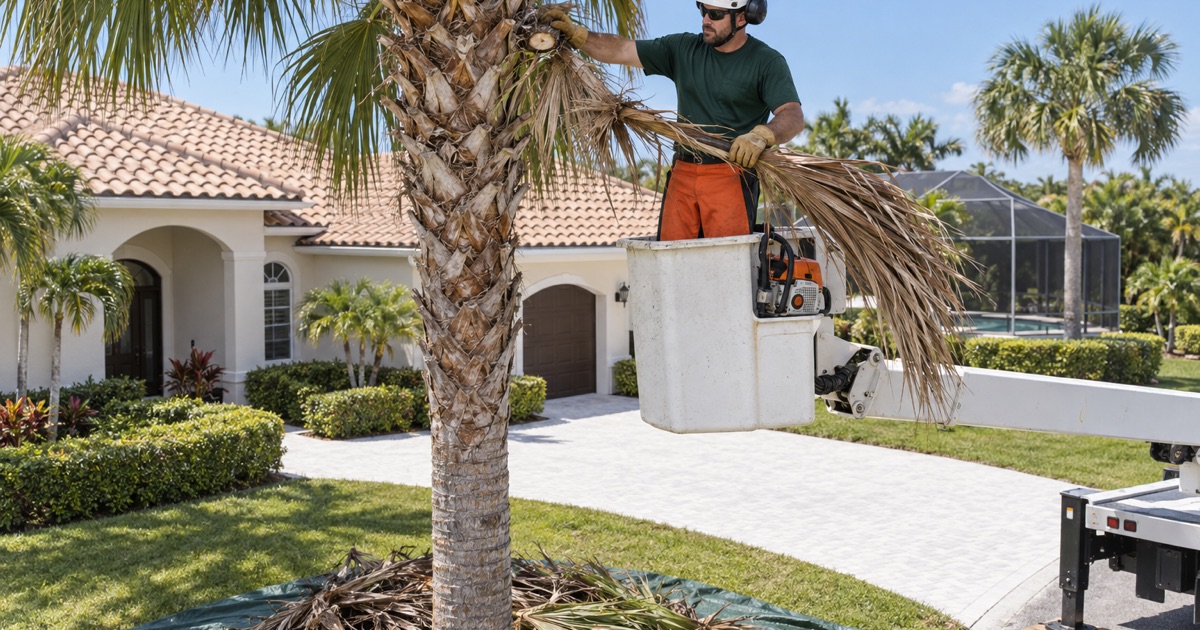
The rule is simple enough to check from the driveway: picture a clock face over the palm crown and take nothing above the nine and three line, which means every frond at or above horizontal stays on the palm. Fronds below that line may come off when they are dead, broken, or genuinely in the way of a walkway, a roof or a light fixture. Green fronds above it are the palm’s working canopy and the mass that damps trunk movement in wind, so removing them costs the palm twice over.
Hurricane Cuts, Hat Racking and Their Real Cost
A hurricane cut, sometimes sold as a storm trim, strips a palm back to a handful of upright fronds; it is the palm’s version of topping, it has genuine demand here every summer, and the research runs directly against it. Hurricane-cut palms were measured as more likely to have their crowns snapped off than palms left fuller, which is the opposite of what the customer was sold. We will not do one, and a meaningful share of our palm work is correcting the aftermath of somebody else’s, a job that starts by explaining what cannot be undone.
Frond Skirts, Seed Stalks and Self-Cleaning Palms
Species decides the work entirely. A royal palm has a crownshaft and sheds its own fronds, so the question is where a fifty-pound frond lands rather than whether to cut it; a Mexican fan holds a dense skirt of dead fronds that harbors wildlife and can slide as a single mass; a queen palm drops heavy seed stalks over whatever is parked beneath it. A state fatality investigation into a worker killed by a sliding frond skirt concluded that a palm with more than three years of dead growth should be treated as hazardous, and we plan skirted palms accordingly.
Palm Disease: What Is Treatable and What Is Not
Ganoderma Butt Rot
Ganoderma zonatum attacks the lower four to five feet of trunk and is effectively undiagnosable until the shelf-shaped conk emerges at the base, by which point the internal trunk is already compromised. There is no treatment, no cure and no way to slow it down, whatever a product label says. The fungus also persists in the soil almost indefinitely, so the honest recommendation is removal, stump grinding, and a different plant in that spot rather than another palm going into the same ground.
Thielaviopsis Trunk Rot
Thielaviopsis attacks the upper third of the trunk and is the one that catches people out, because the palm can look entirely healthy right up to the moment the crown falls off the trunk. It enters through fresh wounds, and that explicitly includes the punctures made by climbing spikes. This is one of several reasons we do not spike a palm we intend to keep: a palm cannot wall off a wound the way a tree does, so every hole made in it stays open for the life of the plant.
Lethal Bronzing and the Injection Program
Lethal bronzing is a phytoplasma with a latent period of roughly four to five months and a host list running past twenty palm species, which is why a neighborhood can lose palms in sequence rather than all at once. The palm showing spear leaf collapse cannot be saved, but neighboring host palms can be protected with trunk injections repeated every three to four months for at least two years. That is a maintenance program with a real running cost, almost nobody in this market sells it, and we quote the whole thing before you start rather than after the first injection.
Palm Removal, Stumps and What Goes Back
Species, Height and the Price Class
Palms are quoted per palm, with species and height setting the class, because a sabal, a queen, a royal and a Mexican fan of identical height are four different removals in weight, mess, disposal volume and the way the trunk has to be taken apart. Identification therefore happens before pricing rather than on the morning of the job. It also decides whether disease is a factor at all, since the three killers above do not affect every species equally.
Tight Access, Pool Cages and Crane Picks
Palms in this market are planted exactly where nothing else fits: between two villas, along a pool cage, beside a seawall, under a service drop. Where a palm cannot be sectioned safely into a clear drop zone, a crane pick is the right tool, and we would far rather quote it than improvise around the problem on the day. The estimate names the machine and the access route, so nobody arrives to find a truck that cannot fit and a job that has quietly become two mobilizations.
Stumps, Grindings and Replanting
A palm stump is a wide mat of shallow fiber rather than a dense plug, so it grinds fast, throws far more water than a hardwood, and produces a noticeably bigger cleanup for its diameter. Where Ganoderma was the reason for removal, the grindings need handling rather than spreading around the beds. On replanting we give a straight answer about what species suits the spot, why the original hole may not be the right one, and when the honest recommendation is a hardwood instead of another palm.
- 20+ Years on This Coast
- Written Estimate Before Any Cut
- No Topping, No Hurricane Cuts