Bonita Springs Tree Removal provides tree disease treatment and plant health care in Bonita Springs, FL, with twenty-plus years on this coast, serving surrounding cities including Estero, Naples Park, Florida Gulf Coast University, Fort Myers Beach and Naples. The service starts with a diagnosis and a written finding, and it ends with a straight answer about what is treatable.
That last part matters here more than it does in most markets, because the three diseases that kill the most palms in Southwest Florida include two that have no treatment at all. A company that will not say so can sell an injection program for a palm that is already lost, and the customer only discovers it when the palm comes down anyway.
The other honest answer we give often is that the problem is not a disease. A great many declining trees on this ground are suffering from compaction, a buried root collar, salt, or roots cut during somebody else’s project, and none of those is fixed by anything sprayed on a canopy.
Diagnosis Before Treatment
What a Site Read Actually Covers
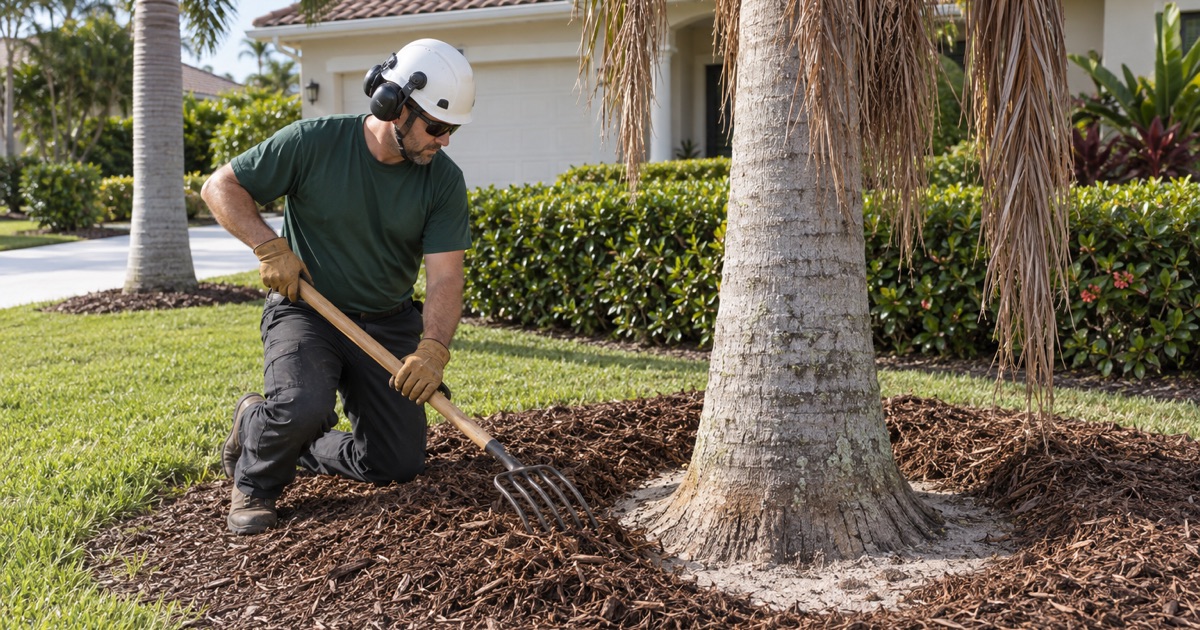
We look at the whole system rather than the symptom: species and its known problems here, the pattern of decline through the canopy, the trunk and any fruiting bodies, the root collar and buttress, the soil and its drainage, and what has been done nearby in the last few years. Recent trenching, a new driveway or a raised bed against a trunk explains more declining trees on this coast than any pathogen does. The finding is written down, with photographs, so the reasoning is on the record.
Root Collar Excavation and the Air Spade
On sand, and under years of added mulch and landscape bed, the root collar is frequently buried, and a buried collar keeps the trunk base permanently damp while hiding girdling roots and decay. An air spade removes that soil without cutting the roots, which a shovel cannot do. It is often the single most informative half hour of an assessment, and where the problem turns out to be the burial itself, the excavation is also most of the treatment.
When the Answer Is Not a Product
We do not run a standing spray or feeding program applied to everything on a property by the calendar. Where a soil read or a diagnosis supports an intervention we quote it, and where it does not we say the tree needs decompaction, mulch corrected, or simply more water in the dry months. Turning down work that would not have helped is easier to explain once than a program that costs money for three years and changes nothing.
Palm Diseases and What Can Be Done
Ganoderma Butt Rot
Ganoderma zonatum is the one people find first, because the shelf-shaped conk at the base is unmistakable once it appears. By that stage it has been working through the lower four to five feet of trunk for a long time, there is no treatment, cure or way to slow it, and removal is the only answer. The fungus survives in the soil more or less indefinitely, so the recommendation includes grinding the stump and not putting another palm back into that footprint.
Thielaviopsis Trunk Rot
Thielaviopsis works in the upper third of the trunk and is far more dangerous to people, because the palm can look completely healthy right up until the crown separates from the trunk. It enters through fresh wounds, which explicitly includes climbing spike punctures, so it is one of the reasons we never spike a palm that is being kept. Where it is suspected, the palm is treated as a hazard rather than as a maintenance item and we plan removal accordingly.
Lethal Bronzing and the Injection Program
Lethal bronzing is a phytoplasma with a latency of roughly four to five months and a host list running past twenty palm species, which is why a neighborhood tends to lose palms in sequence rather than all together. The palm showing spear leaf collapse is gone, but its neighbors can be protected with trunk injections repeated every three to four months for at least two years. Almost nobody in this market sells that program, and we quote the full two-year cost before the first injection rather than after it.
Soil, Roots and Tree Decline
Compaction and Soil Decompaction
Sand compacts, and once it does the pore space that roots need for air is gone, which is why trees inside old construction footprints and along parking areas decline for no visible reason. Air spade decompaction, sometimes with amendment worked into the fractured soil, restores that structure without severing roots the way tilling would. Combined with a proper mulch ring kept off the trunk itself, it is the most reliable non-chemical intervention available on this ground.
Laurel Oak Decline and Species Life Span
Laurel oak is the market’s structural removal driver and it runs a working life of roughly fifty to seventy years, so a street platted at one time reaches the end of that span at one time. When several neighbors call in the same season it is usually age rather than an outbreak. What we assess on each tree is whether the decline is safe or unsafe, since basal decay, a compromised root plate and a co-dominant union with included bark change the recommendation far more than thin canopy does.
Salt, Drainage and the Water Table
Salt reaches trees here in more than one way: surge inundation over the root zone, spray on exposed coastal lots, and irrigation water that is saltier than anyone assumed. Damage from inundation is slow and out of sequence, so a tree can carry green canopy for a season or two before declining. Add a seasonal water table that sits within eighteen inches of the surface for months on Myakka ground, and drainage becomes part of any honest plant health plan here.
- 20+ Years on This Coast
- Written Estimate Before Any Cut
- No Topping, No Hurricane Cuts