Bonita Springs Tree Removal handles land clearing and lot clearing in Bonita Springs, FL, with twenty-plus years on this coast, serving surrounding cities including Estero, Naples Park, Florida Gulf Coast University, Fort Myers Beach and Naples. Clearing here is site work as much as tree work, and we quote it that way: what comes off, what stays, what gets mulched in place and what leaves on a trailer.
The decision that costs the most money if it is made late is which trees are staying. A specimen oak left standing inside an unprotected work area is usually a dead oak two years later, killed by compaction under a track rather than by anything anyone cut. Protecting the keepers is the first task on our schedule, not a courtesy at the end.
The second decision is legal rather than mechanical. Vacant and platted-but-unbuilt land sits outside the residential exemption that covers a homeowner’s own yard, so clearing runs through the ordinary permit route, and Lee, Collier and Hendry all answer that question differently. We establish which authority governs the parcel before a machine is booked.
Forestry Mulching and Mechanical Clearing
How Mulching Works, and Where It Fits
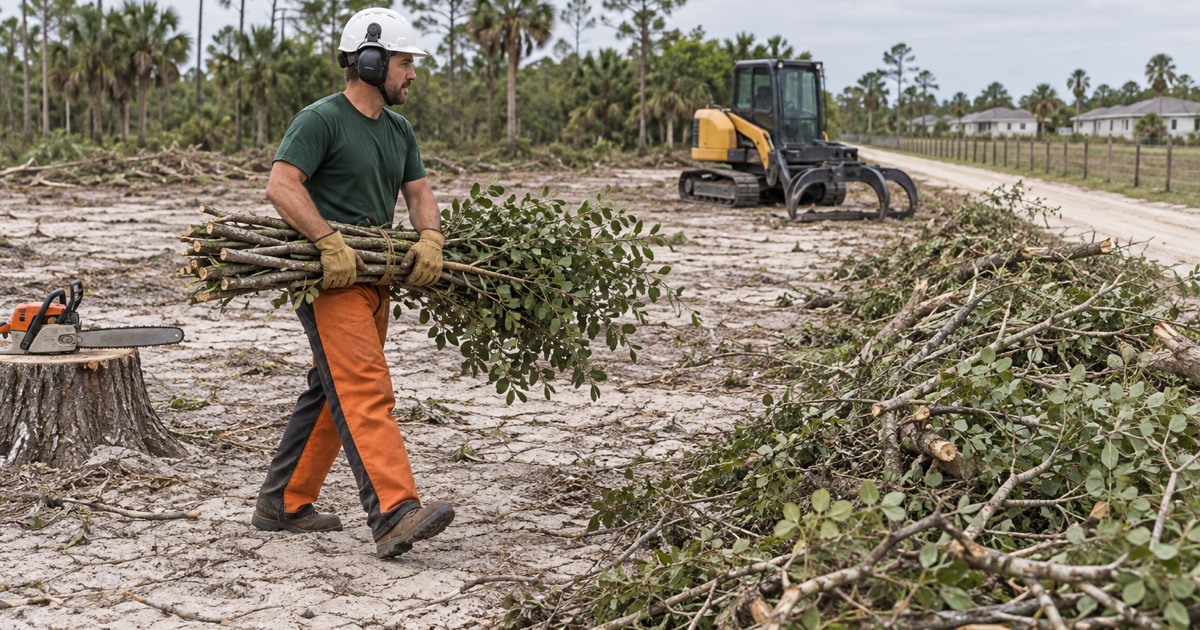
A mulching head processes standing stems where they grow and leaves the material on the ground as a mat, so there is no pile, no burn and no hauling bill attached to the work. On sand that mat is genuinely useful, because it holds the surface together through a rainy season instead of letting it move. Mulching suits light-to-medium regrowth, exotic thickets, trail and fence-line work, and any parcel where the owner wants sight lines and access without a full clear.
Where Mulching Is Not Enough
Mulching does not remove root systems, so wherever footings, a pad, a driveway, a pool shell, utilities or a drain field are going into the cleared footprint, the roots have to come out and that means grubbing rather than grinding the tops. We say which of the two a site actually needs at estimate time rather than after mobilizing. Selling a mulching job on a parcel that will need grubbing three weeks later does not save anybody money; it just moves the same cost into somebody else’s contract.
Selective Clearing and Protecting the Keepers
Selective clearing starts with marking: we walk the parcel with the owner or the builder, tag what stays, and fence those root plates out to a working radius before the first machine moves onto the site. Compaction is the failure mode here and it is completely invisible on the day. A tree that spent a week with tracks running over its root zone declines slowly and dies well after the crew and the memory of the crew have gone, which is exactly why the fence goes up first rather than last.
Site Work: Grubbing, Grading and What the Builder Needs
Grubbing Root Balls and Stumps
Grubbing pulls the root balls and stumps out and leaves ground a builder can work, but it opens far more soil than mulching does, produces material that has to be hauled, and needs a plan for the holes it leaves behind. On a mature laurel oak or a large ficus the root system is wide enough that grubbing near a property line, a seawall or a neighbor’s tree becomes a conversation about where the excavation stops. That conversation is much cheaper before the machine starts than after it.
Working With the Soil You Actually Have
Ground conditions across this city are not uniform, and a single parcel can straddle two of them. On Myakka fine sand there is a cemented layer within a couple of feet of the surface and a seasonal water table sitting under eighteen inches for part of the year; inland depressional ground is clean sand that ponds for months; near the water there is tidal muck that will not carry a machine at all. Each of those changes what equipment can work, when it can work, and how much of the site can be staged on at once.
Coordinating With the Trades That Follow
A cleared lot is an input to somebody else’s schedule, so we agree in advance where the spoil goes, which access route stays open, where material can be stockpiled, and what condition the ground has to be in when we leave it. Getting that agreed is what keeps a clearing job from turning into an extra line on the excavation contract later. It is also the part a tree crew unused to site work almost always leaves out of its quote.
Permits, Preserves and Protected Vegetation
The Residential Exemption Does Not Cover Vacant Land
Florida Statutes section 163.045 is a genuinely useful exemption and it does not apply to a clearing job, because its definition of residential property is a single-family detached building on a lot actively used for single-family residential purposes. That leaves out vacant land, platted-but-unbuilt lots, commercial, industrial and agricultural parcels, and every attached dwelling type there is. So the vegetation removal permit question is live on a clearing job even where the same owner could have taken a hazard tree out of their own yard without one.
Three Counties and Their Municipalities
Lee County runs vegetation removal permitting through its Land Development Code, Collier through Land Development Code section 3.05.00, and Hendry on its own schedule, while Bonita Springs, Sanibel, Marco Island and Naples each add a municipal layer on top of the county one. We work the address rather than the county name, and we establish it before anything is booked. A parcel a few hundred feet the wrong side of a line is a different application, a different fee and sometimes a different answer entirely.
Preserves, Indigenous Areas and Wetland Lines
Any preserve, indigenous area or protected wetland on the parcel is a hard boundary, and it can pull state permitting into a job that looked entirely local on paper. Cutting inside one exposes an owner to a restoration planting plan that may require more vegetation than was standing there before, which is a far worse outcome than a fee. We locate and physically flag those lines at the start of the job, because a line that exists only on a plan sheet is a line no operator can see from a cab.
Exotics, Debris and What Leaves the Site
Invasive Removal the Code Requires
On parts of this ring, removing exotics is an obligation rather than an option: Sanibel requires named invasive species removed before a certificate of occupancy and kept out in perpetuity, and Collier County imposes a comparable requirement under its own code. Australian pine, melaleuca, Brazilian pepper and earleaf acacia are the usual list. They also behave differently under a machine, since melaleuca reseeds aggressively after disturbance, Brazilian pepper resprouts from cut stumps, and Australian pine leaves large trunk material that has to be hauled rather than mulched.
Disposal Priced by the Ton
Material leaving a clearing job is weighed at the gate and a clean horticultural load prices below a mixed one, so keeping soil, fencing wire and construction debris out of the load is worth real money at this scale rather than being a matter of tidiness. Origin can matter too, because the same facility may charge a different per-ton rate for material arriving from a different county. We show the disposal rate on the estimate instead of absorbing it into a price per acre where nobody can check it.
Documenting What Came Out
On permitted clearing, on invasive removal tied to a certificate of occupancy, and on any parcel carrying a preserve line, what was removed is part of the deliverable rather than an afterthought. We photograph and record the work, note what was left standing and why it was left, and hand that over with the invoice. For an owner who is not on site, and on this coast a great many owners are not, that record is the only version of the job they will ever actually see.
- 20+ Years on This Coast
- Written Estimate Before Any Cut
- No Topping, No Hurricane Cuts