
Bonita Springs Tree Removal has been grinding stumps in Bonita Springs, FL for twenty-plus years, serving surrounding cities including Estero, Naples Park, Florida Gulf Coast University, Fort Myers Beach and Naples. Stump work is quoted as its own line rather than buried in a removal price, so you can see what you are paying for the hole, the grindings and the haul-off separately.
That separation exists because stump grinding here is a soil job as much as a wood job. Twenty years on this coast is twenty years of learning what a wheel meets under a Bonita Springs yard, and it is rarely rock: it is cemented hardpan on one street, clean sand that ponds on the next, and tidal muck a few blocks west that will not hold a machine at all.
We also say in advance what we are committing to. The estimate names a below-grade depth, states whether the grindings are going back in the hole or leaving on a trailer, and flags anything buried that will cap how deep the wheel can safely go. A stump job that goes wrong almost always went wrong because none of that was agreed before the machine arrived.
What Stump Grinding Involves
The Wheel and the Below-Grade Cut
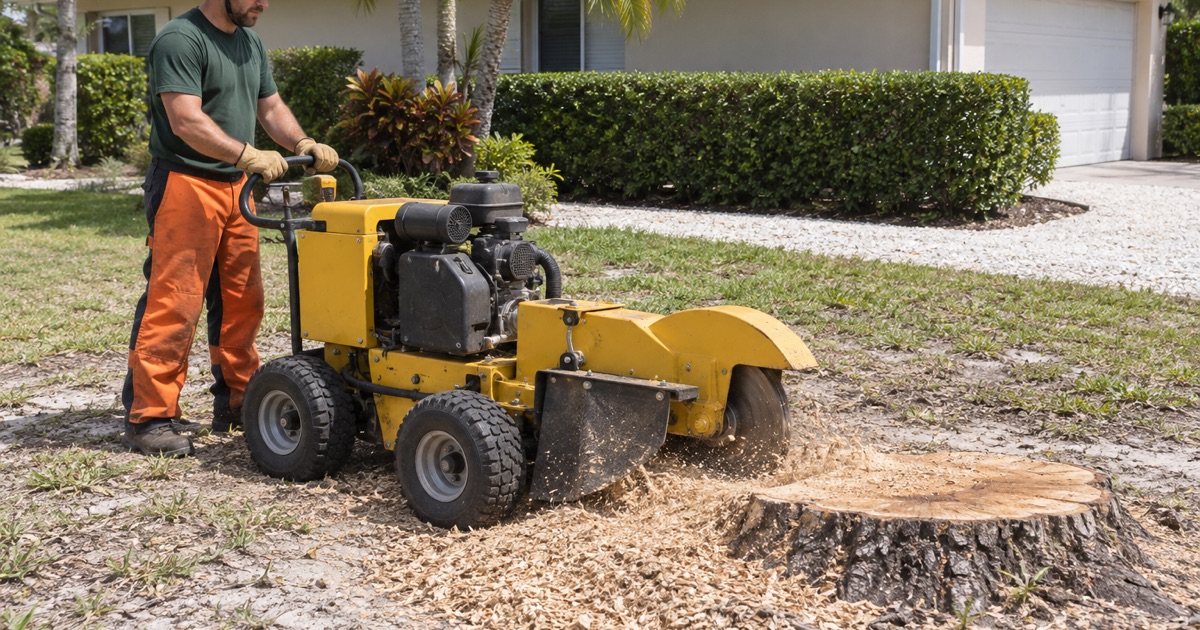
A stump grinder is a cutting wheel carrying carbide teeth that sweeps across the stump face, taking the wood down in passes rather than pulling it out, and typical machines are rated for a below-grade cut somewhere between twelve and twenty-five inches. The practical depth, though, is whatever the machine that can physically reach the stump is rated for, which is why access and depth are one question rather than two. A large tow-behind unit will go deeper than a narrow-gate machine, but if it cannot get through a five-foot side gate then the deeper rating is theoretical.
Grinding Against Full Stump Removal
Grinding converts the stump into chips and leaves the root system in the ground to decay, while full removal means excavating the root ball, which takes a machine, opens a much larger hole, and disturbs everything around it including irrigation, sod and neighboring root plates. Grinding is the right answer for almost every residential stump on this coast. Excavation earns its considerably higher cost only where a foundation, a pool shell, a new driveway or a drain field is going into that exact footprint and the roots genuinely cannot stay.
What the Price Actually Covers
Our stump line covers exposing the collar, grinding to the stated depth, and clearing the immediate work area, while backfill, sod repair, hauling the grindings away and chasing lateral roots out from the stump are separate lines carrying their own numbers. They are shown that way so you can take or leave each one on its merits rather than accepting the whole package. A single lump figure hides exactly the parts customers care about afterward, which is the crater sitting in the lawn and the question of who is filling it.
Depth, Soil and What Stops the Wheel
Myakka Hardpan and the Spodic Layer
Large parts of this city sit on Myakka fine sand, a soil whose cemented spodic horizon runs roughly twenty to thirty-six inches below the surface, which puts it inside the range a grinder is rated for. On Myakka ground the wheel therefore reaches genuinely dense material well before it reaches anything resembling rock. It is a hard layer rather than an impossible one, but it slows the cut and changes how long a stump takes, and knowing the ground before quoting is the difference between an honest number and a surprise.
Limestone, Clean Sand and Depressional Ground
Inland toward the interstate the map changes completely: depressional soils there run clean sand well past the depth any wheel reaches, with fractured limestone sitting far deeper than a grinder goes, so the cut itself is straightforward. What limits work on that ground is water rather than hardness, because those areas pond for months at a time in most years. On the coastal edge the soil is tidal muck, very poorly drained and very frequently flooded, where the honest answer is that there is nothing solid to stand a machine on until it dries.
The Seasonal High Water Table
The seasonal high water table on Myakka ground sits within eighteen inches of the surface for one to four months in most years, which matters more to a stump job than almost anything else about the soil. A grinder working saturated sand throws slurry instead of chips, packs its teeth, and leaves a hole that refills as fast as it is cut. We would rather move a stump job by a week than fight water for an afternoon and hand back a muddy crater, and we will say so when that is the recommendation.
Palm Stumps, Hardwood Stumps and Root Systems
Grinding a Palm Stump
A palm has no taproot and no tapering laterals, because every root is adventitious, emerges from the base at its final diameter, and runs out shallow and fibrous, which makes a palm stump a wide wet mat rather than a dense plug. Sabal palmetto roots also branch at a very low rate when cut, so severing them does not trigger the regrowth a hardwood would attempt. The practical result is that palm grinds quickly, throws far more water than a hardwood, and needs a larger cleanup allowance at the same trunk diameter.
Laurel Oak, Ficus and Surface Roots
Laurel oak is this market’s structural removal driver, and a mature one leaves a wide buttress with substantial surface roots radiating out under the lawn; ficus is worse still, because its roots travel a long way and go on lifting hardscape after the tree itself is gone. Grinding the stump does nothing about those runs. Where a driveway, a walkway or a pool deck is being lifted, root pruning at the affected edge is a separate scope, and it needs an eye on how much anchorage a nearby standing tree can afford to lose.
Ganoderma and What Not to Replant
When a palm comes out because of Ganoderma butt rot the stump is not simply a stump, because Ganoderma zonatum persists in the soil more or less indefinitely and there is no treatment for it at any stage. We grind the stump out and then advise against replanting another palm anywhere in that footprint. Saying that plainly costs us a replanting sale and saves the customer buying the same palm twice, which is exactly the sort of thing a written recommendation exists to do.
Access, Grindings and Putting the Yard Back
Narrow Gates, Pool Cages and Machine Size
The machine that fits is the machine that does the work, so we size it to the gate, the turf and the overhead clearance before quoting rather than afterward. Narrow-gate units get through a fenced side yard; larger units stay on open lots and commercial sites where they can be walked in without lifting fence panels. On saturated sand, wide dual wheels are the configuration that floats a machine rather than the one that sinks it, which is the opposite of how the same tires behave on firmer ground elsewhere.
The Crater and the Mound
Grinding always produces two things nobody pictures in advance: a bowl where the stump was, and a mound of grindings two to three times the volume of that bowl, because the material is aerated on the way out. We agree beforehand which of three things happens to it. The grindings go back into the hole and mound slightly to allow for settlement, they get raked out thin across beds as mulch, or they leave on the trailer as a priced disposal line.
Backfill, Sod and Replanting
Grindings alone make poor soil: they are wood, they tie up nitrogen as they break down, and a hole filled purely with them settles noticeably over the first year. Anywhere sod or a new plant is going in, we therefore bring clean fill and top the last few inches with soil rather than leaving the yard to settle around a wood-filled bowl. Where the plan is a replacement tree, we say where to put it instead of defaulting to the same hole, because the old root plate, the grindings and any disease history all argue for moving a few feet.
- 20+ Years on This Coast
- Written Estimate Before Any Cut
- No Topping, No Hurricane Cuts