Bonita Springs Tree Removal has done hedge trimming, shrub work and brush removal in Bonita Springs, FL for twenty-plus years, serving surrounding cities including Estero, Naples Park, Florida Gulf Coast University, Fort Myers Beach and Naples. It is the same crews and the same standards as the tree work, priced by the job with hauling shown separately.
The difference between hedge work here and hedge work almost anywhere else is that nothing stops growing. There is no dormant season to buy a few quiet months, so a screen that is cut once a year is a screen that spends most of the year out of shape, and an unattended side yard closes in a single wet season.
We also look at what a planting actually is before cutting it. A privacy screen, a code-required landscape buffer, a stand of mangrove kept low by somebody’s hedge trimmer and an exotic thicket a local code requires you to remove are four different legal situations that can look identical from the street.
Hedges, Screens and How Often They Want Cutting
Ficus, Clusia and Podocarpus Privacy Screens
The common privacy species here behave very differently on a schedule. Ficus grows hard and fast, holds a tight face beautifully, and needs frequent visits plus an eye on its roots, which travel further than the hedge does. Clusia and podocarpus are slower and more forgiving of a longer interval, so they suit an owner who is not here year round. We match the interval to the species and the season rather than selling everyone the same quarterly visit.
Sea Grape and Coastal Screens
On coastal lots the screen is often sea grape, and it is not a plant to treat as ordinary landscaping. It can be regulated separately from other vegetation on barrier islands, and work seaward of the Coastal Construction Control Line brings its own constraints regardless of species. We establish what applies to the address before quoting, because a coastal hedge cut back on the wrong side of a line is a compliance problem rather than a maintenance one.
Shearing Against Selective Reduction
Shearing keeps a crisp face and, done exclusively, gradually hollows a hedge out: the outer shell thickens, light stops reaching the interior, and the base goes bare. Alternating shearing with selective reduction cuts inside the canopy keeps some interior growth alive and slows that decline considerably. Keeping the base wider than the top is the other half of it, and it is the single most common thing a neglected hedge here has got wrong.
Shrub Beds, Overgrowth and Understory Work
Reclaiming an Overgrown Bed
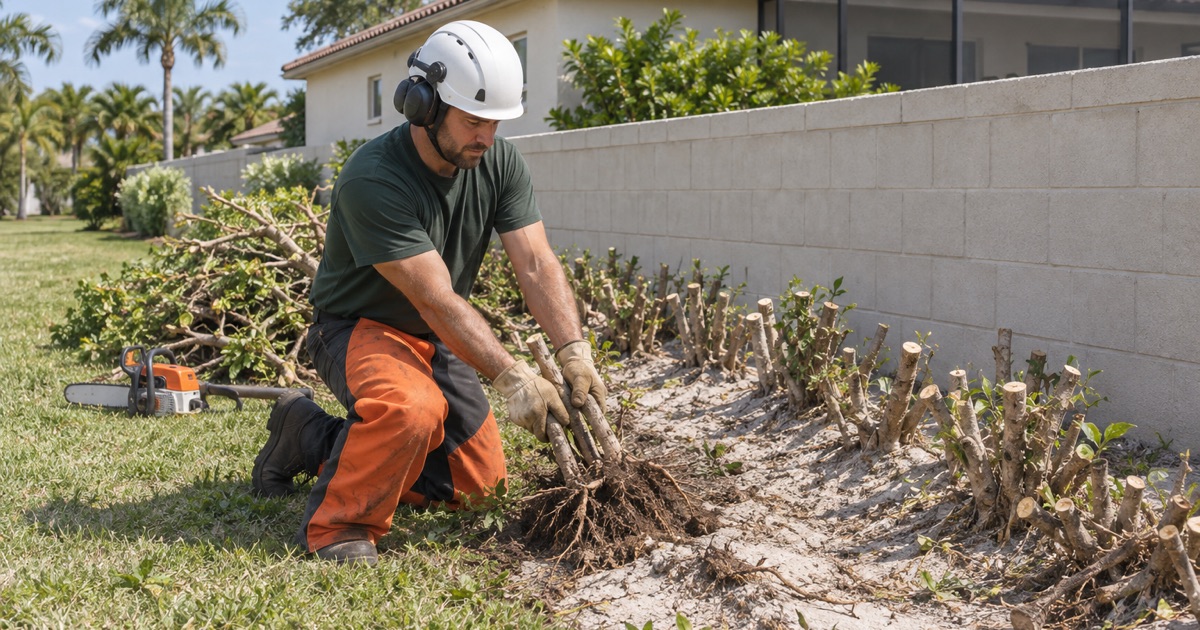
A bed that has closed over is usually a sorting job before it is a cutting job. We work out what is worth keeping, what has been swamped and can recover with light, and what is simply in the wrong place at its mature size, then clear to a defined line rather than an approximate one. Clearing back to a line you agreed beforehand is what keeps a reclamation from turning into an argument about how much was supposed to go.
Clearance From Walls, Roofs and Equipment
Planting hard against a wall, a roof edge, an air handler or a pool cage holds moisture where it is least wanted and gives insects a bridge. Keeping a real gap is worth more than it looks, and it is easier to maintain if the planting is reduced properly rather than sheared flat against the structure each visit. Where a shrub has genuinely outgrown its position, we will say so instead of cutting the same plant back to a wall four times a year.
Renovation Pruning, Staged Properly
Some overgrown shrubs can be cut hard and regrown, and some cannot, which is entirely a species question. Where hard renovation is viable we usually stage it over more than one season rather than taking everything at once, so the plant keeps enough foliage to feed the regrowth it is being asked to produce. Where it is not viable, replacement is the honest recommendation and we would rather give it than take payment for a plant that will not come back.
Brush Removal, Exotics and Disposal
Brush Clearing and Fence Lines
Fence lines, side yards, canal banks and vacant edges close in quickly here, and clearing them is mostly about deciding where the finished line sits and what stays standing. We clear to that line, protect anything you are keeping, and leave the ground in a condition somebody can maintain rather than a condition that regrows into the same problem in six months. On larger areas, mulching in place is often better value than cutting and hauling.
Brazilian Pepper and Exotic Thickets
A great deal of the brush here is not native, and the exotics do not behave like ordinary overgrowth. Brazilian pepper resprouts vigorously from cut stumps, melaleuca reseeds heavily after disturbance, and earleaf acacia and Australian pine leave material too large for a chipper. Removal is also required rather than optional in parts of this ring, including under Collier County’s own code, so we clear to the applicable list and record what came out.
Gate Rates, Clean Loads and What It Costs to Haul
Everything that leaves is weighed, and a clean horticultural load prices below a mixed one, which is why old fencing, irrigation pipe and construction scrap stay out of the trailer rather than riding along. On a large clearance that separation is a meaningful share of the bill. The disposal rate goes on the estimate as its own line, so the hauling cost is visible instead of hiding inside a labor figure.
- 20+ Years on This Coast
- Written Estimate Before Any Cut
- No Topping, No Hurricane Cuts