Bonita Springs Tree Removal has handled tree trimming and pruning in Bonita Springs, FL for twenty-plus years, serving surrounding cities including Estero, Naples Park, Florida Gulf Coast University, Fort Myers Beach and Naples. Every cut we make is a cut to a live lateral or to the branch collar, which is the whole difference between pruning a tree and damaging it slowly.
We do not top, we do not hat rack, and we do not sell hurricane cuts on any tree or palm. Those three practices have real demand here and they are the reason a great many of our calls are corrective work on somebody else’s pruning, done five or six years after the fact when the regrowth has become the hazard.
What we do instead is name the job. The estimate says whether we are cleaning, thinning, reducing or raising the crown, on which trees, and to roughly what extent, so you can see what you are buying rather than paying for an unspecified afternoon with a saw.
What Proper Pruning Actually Does
Cutting to the Branch Collar
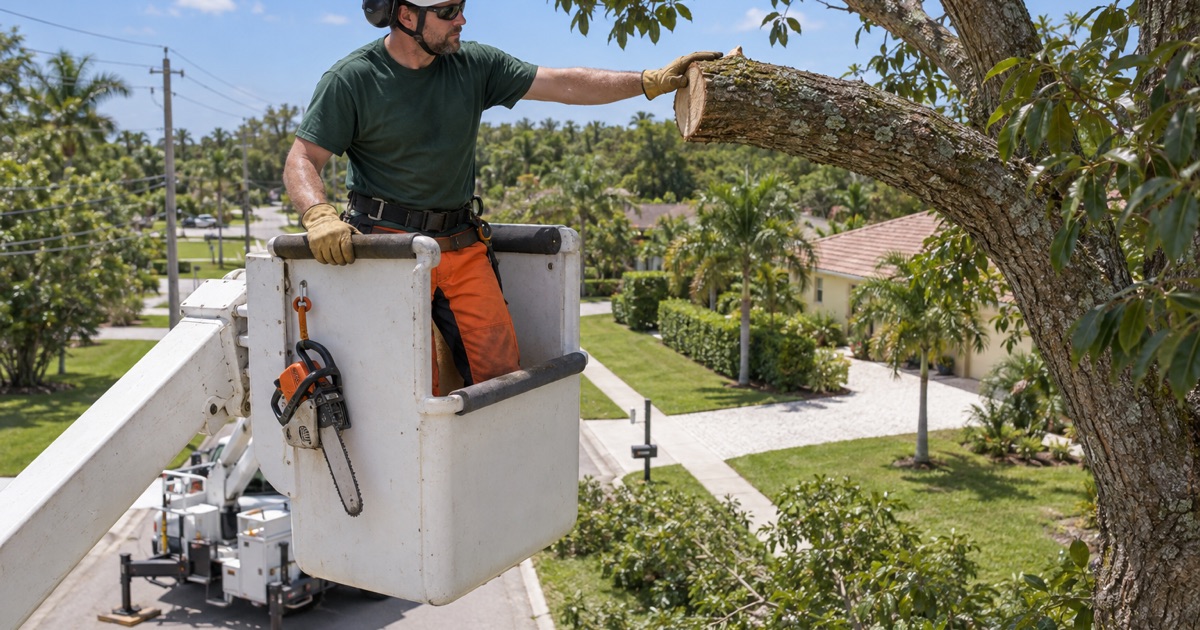
A tree cannot heal a wound; it walls the wound off, growing new tissue around it from the branch collar at the base of the limb, so a cut outside that collar leaves a stub the tree can never close over while a cut flush into the trunk removes the tissue that does the closing. The target is therefore a narrow one, and hitting it consistently on a large limb takes a three-cut sequence that removes the weight before the final cut is made. That is basic craft, and it is also the most reliable single thing to look at when judging whether a crew knew what it was doing.
Directional Pruning and Crown Reduction
Reduction shortens a limb by cutting it back to a lateral branch already large enough to take over as the new leader, so the tree keeps a natural outline, the wound has a live limb feeding it, and future growth heads in the direction that lateral was already going. That is how a crown gets pulled back from a roof, a pool cage or a service drop without leaving a sheared face along the property. It takes longer than shearing, costs a little more on the day, and does not need doing again the following year.
Why We Never Top or Hat Rack
Topping and hat racking cut to stubs at an arbitrary height, and the tree answers with a crowd of sprouts anchored only in the outer rings of a wound it cannot compartmentalize. Those sprouts grow fast, get heavy, and fail in wind at exactly the height the original cuts were made, which is why so much of our corrective work is on trees topped half a decade ago. ANSI A300, the industry’s own maintenance standard, and Lee County’s published maintenance guidance both point the trade firmly away from the practice.
Pruning for Storm Season
Thinning, Wind Load and What Actually Fails
A dense, unthinned crown behaves like a sail, and selective interior thinning lets air pass through it instead of pushing on the whole canopy, without removing the mass and flexibility a tree needs to move with a gust rather than resist it. What fails in a storm is rarely a healthy tree of ordinary shape. It is a decayed root plate, a co-dominant union with included bark, a large piece of deadwood, or a crown that was topped years ago and rebuilt itself out of weak sprouts.
Deadwood, Cracks and Co-Dominant Unions
Deadwood comes out first, because it is the material most likely to be thrown and the easiest to remove at no cost to the tree, and cracks, old failure points and unions where two similar leaders trap bark between them get inspected on the same visit. Where a union is the problem, pruning is usually only half the answer. Subordinating the weaker leader shifts growth away from the defect over several seasons, and a dynamic cable in the upper crown shares the load while that slow change happens.
Booked Before the Season, Not After It
We schedule reduction and structural work in spring and early summer, while there is room on the calendar and while the tree still has a growing season ahead of it to respond to the cuts. Once a warning is posted for this coast the same work becomes an emergency queue and everybody wants the same crew in the same week. Pre-season work is also the version that gets priced calmly, because nothing about a tree gets cheaper once a storm has taken over the schedule.
Species, and What Each One Wants
Laurel Oak, Live Oak and the Fifty-Year Problem
Laurel oak grows fast, forms co-dominant unions readily, and runs a working life of roughly fifty to seventy years, so in neighborhoods platted together a whole street of them reaches the end of that span at once and pruning shifts from shaping to managing decline. Live oak is a different tree on a much longer horizon, and it repays structural pruning done early in its life. Telling the two apart in a yard where both were planted is the first thing an honest estimate here has to get right.
Gumbo Limbo, Sea Grape and Coastal Species
Gumbo limbo is soft-wooded, sheds limbs readily and responds poorly to heavy cuts, so it wants light and frequent attention rather than an occasional severe visit. Sea grape is often maintained as a hedge on coastal lots and can be regulated separately from other vegetation on barrier islands, which changes what may be done to it and by whom. Coastal properties also bring the Coastal Construction Control Line into the conversation, since that line affects work seaward of it regardless of the species involved.
Mangroves Are Not a Pruning Job
Mangroves sit outside ordinary trimming entirely: they are governed by the Mangrove Trimming and Preservation Act, they are expressly excluded from the state’s residential permit preemption, and the state certifies professional mangrove trimmers to work on them. On a waterfront lot the mangrove fringe and the upland trees are therefore two separate legal questions attached to one property. We treat them that way rather than running a crew along the whole shoreline and sorting out the paperwork afterward.
Standards, Permits and Association Work
ANSI A300 and What the Local Documents Say
ANSI A300 is the trade’s maintenance standard, and it is worth citing by name rather than by clause number, because the numbering differs between parts and between editions. Lee County’s own maintenance guidance points residents to A300 and to extension material explaining why topping hurts trees, while the City of Bonita Springs states the same substance in older words, requiring that vegetation be pruned only to promote healthy, uniform, natural growth. Different vocabulary, one rule, and it is the rule we work to.
Code-Required Trees and Protected Areas
Not every tree in a yard is the owner’s to shape freely, because trees required by an approved landscape plan, and anything inside a preserve, indigenous area or protected wetland, carry obligations ordinary yard trees do not. Cutting one of those can trigger a restoration planting plan rather than a flat penalty, which is a far more expensive outcome. Whether a tree is required often turns on when the site was permitted, and for a great deal of housing here that means a county file rather than a city one, so we check before we cut.
Association, Resort and Commercial Cycles
Community associations, districts, resorts and commercial properties get considerably more from a pruning cycle than from reactive calls, so we inventory by location, prune on a schedule, and report what changed after each visit. That lets a manager budget by risk rather than by whoever complained most recently, and it builds the record showing a known issue was addressed. For seasonal and second-home owners we do the same thing in miniature, with written findings and photographs so the work still means something when nobody was standing in the yard.
- 20+ Years on This Coast
- Written Estimate Before Any Cut
- No Topping, No Hurricane Cuts